

The “AI bubble” and your retirement
 By Chelsea Traver
If you’ve been reading the headlines about an “AI bubble” and wondering whether this is a risky time to have your savings invested, you’re not alone. A number of clients have raised this with us recently. It’s understandable to feel concerned, particularly if you’re at or approaching retirement and will rely on your investments to provide an income.
The good news is that you don’t need to predict what markets will do next for your retirement plan to remain on solid ground. A well-constructed plan is designed to provide you an income through the good years and the more challenging ones alike.
In this article, I’ll explain what’s happening in markets, why concerns about an AI bubble are understandable, what history can teach us about downturns and, most importantly, how you can position yourself to weather market volatility and maintain confidence in your retirement plan, even if the bubble bursts.
1. Where things stand
Global markets have performed strongly over the past couple of years, with much of the growth in the US share markets driven by a relatively small group of large technology companies connected to artificial intelligence.
This has increased the concentration of the US share market to a handful of companies. However, it’s worth remembering that many of these businesses, including Microsoft, Apple, and Google, have been around for decades. They are highly profitable, generate earnings from a range of products and services, and are not reliant on AI alone for their success.
Even so, a significant proportion of the US market’s value is tied to a small number of companies. This means their performance can have an outsized influence on the broader market, making it understandable that investors are paying closer attention to the risks.
Valuations are another concern people have. By some long-term measures that compare share prices with company earnings, US shares are expensive relative to their historical average, with valuations reaching levels last seen around the dot-com boom. High valuations don’t necessarily mean a market downturn is imminent, but they can leave less room for disappointment if company earnings or growth expectations fall short.
2. Why the nerves are understandable
The concerns largely come down to three things: the US market has become concentrated, share prices are relatively high, and expectations around AI is substantial. When so much optimism is already reflected in the prices, even a modest setback can trigger a market reaction.
For retirees or those approaching retirement, these concerns are heightened. When you are building your savings, a market decline may simply mean a temporary drop in the value of your investments. When you’re drawing an income, however, those investments are also helping to fund your day-to-day life. Additionally, when you are withdrawing, the order in which good and bad years arrive matters. A weaker stretch early on means selling more to fund the same lifestyle. It’s called the sequence of returns risk and can have a material impact on your overall retirement.
3. What history suggests
It’s natural to wonder what the worst-case scenario might look like, and one of the most common comparisons is the dot-com crash of the early 2000s.
During that period, technology shares fell sharply, and some took many years to recover. There are important differences between then and now. Many of today’s leading technology companies are established, profitable businesses, with substantial earnings and real customers. By contrast, many companies caught up in the dotcom boom had little revenue, no profits and uncertain prospects.
The more important lesson is how investors positioned themselves to cope with a downturn. Having cash and other relatively defensive investments available to fund spending can reduce the need to sell shares during a downturn, giving the growth portion of the portfolio more time to recover. It doesn’t eliminate investment risk, but it can help make a difficult period more manageable.
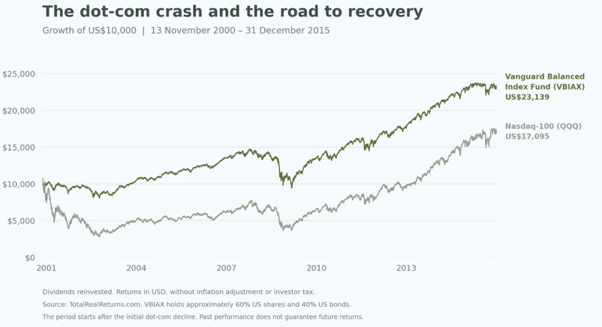
The graph below illustrates how a balanced investment strategy and the technology-heavy NASDAQ performed following the dotcom crash. In the periods shown, the balanced strategy took four years to recover compared to 13 years for the NASDAQ. This highlights how a how a diversified portfolio can behave differently from one concentrated in a single market sector, although the outcome depends on the assets held, the timing and the period measured.
4. Your checklist: how to prepare for a possible AI bubble burst
You don’t need to predict what markets will do next or make dramatic changes to your investments. The aim is to simply make sure your savings are well-positioned to withstand a downturn, should one occur.
- Check how concentrated your investments are — and diversity if needed. Make sure your portfolio is spread across regions, sectors and asset classes, so no single company, market or theme, including AI, has to much influence over your retirement. If you are unsure how diversified your investments are, an adviser can help you assess them.
- Maintain an appropriate cash buffer. Having enough accessible cash and other relatively defensive assets to cover unexpected expenses and planned withdrawals can reduce the pressure to sell growth investments when markets are down. The right amount will depend on your spending needs, other income sources and overall investment strategy.
- Identify spending you could potentially reduce or defer. Consider which discretionary expense, such as a major trip or large one-off purchase, you could put on hold during a particularly poor market year. You may never need to do so, but knowing you have some flexibility can provide valuable peace of mind.
- Resist the temptation to stay in cash. Staying entirely in cash can feel safe when markets are uncertain, but it introduces other risks. Over a 25-to-30-year retirement period, inflation can gradually eroded the purchasing power of cash. Remaining appropriately invested gives your portfolio the opportunity to benefit from future market recoveries, while maintaining a level of risk that suits your circumstances.
- Get a second opinion. A review with a financial adviser can help confirm that your investment mix, cash reserves and withdrawal strategy remain appropriate for your needs. It’s an opportunity to identify any vulnerabilities, make adjustments where necessary and gain confidence that your plan can withstand different market conditions.
The bottom line
No one can predict exactly what markets will do next, and your retirement plan shouldn’t depend on anyone being able to. A well-diversified portfolio that holds an appropriate cash buffer and some flexibility in your spending can help you weather the market downturns without losing sight of your long-term goals.
You can’t control what markets do, but you can control how well prepared you are. The aim isn’t to eliminate risk or avoid every downturn; it’s to build a retirement plan that can withstand the ups and downs and continue supporting the life you want to live.
This article provides general information only and does not constitute personal financial advice. Please talk to us about your individual circumstances before making any investment decisions.
