

Market Update September 2026
 By Mike Ross
International shares
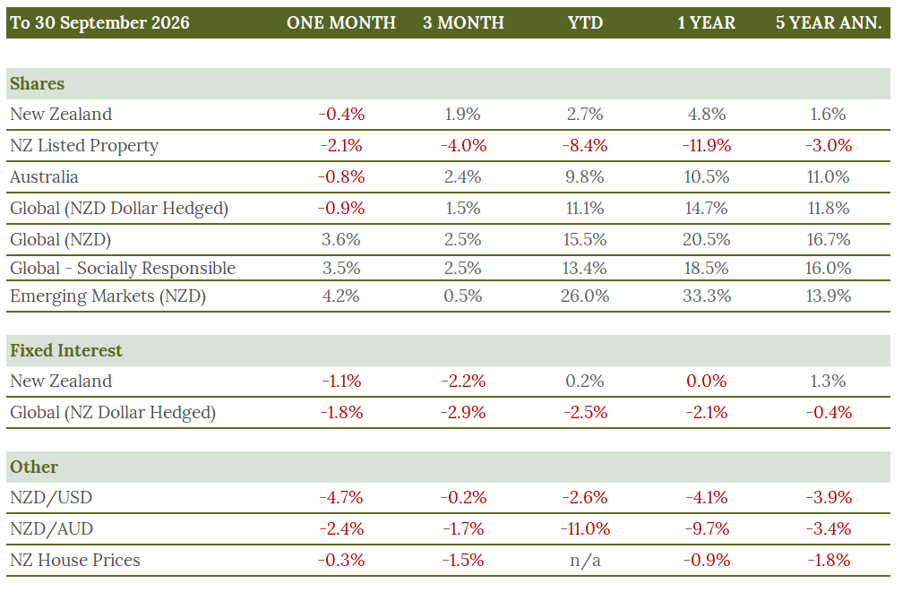
September was a difficult month for most global share markets as sharply rising bond yields weighed on investor sentiment. The experience was quite different for New Zealand investors with unhedged overseas holdings. The New Zealand dollar fell approximately 5% against the US dollar, turning weaker underlying market performance into a strongly positive return of 3.6% when measured in New Zealand dollars.
The US share market declined despite continued strength among some of the largest technology companies. Strong earnings expectations and continued investment in artificial intelligence supported businesses connected to data centres, semiconductors and cloud computing. However, performance beneath the headline indices was considerably weaker, with smaller companies and interest-rate-sensitive sectors particularly affected by higher interest rates. Global equities fell by more than 1% in US-dollar terms during September, while European shares declined more sharply.
Emerging-market shares were the strongest-performing segment for New Zealand investors, gaining 4.2% and taking their year-to-date return to 26.0%. The weaker New Zealand dollar provided a substantial benefit, while earnings expectations remained strong across several Asian technology markets. Performance was nevertheless uneven. Korean shares came under pressure after their earlier AI-driven gains, while India fell sharply as foreign investors withdrew capital in response to higher US interest rates and a stronger US dollar.
Australasian shares
The New Zealand share market fell 0.4% in September but remained positive over the quarter. Local companies were caught between some encouraging company updates and the broader pressure from rising interest rates.
Infratil upgraded its earnings guidance, supported by growing demand across its data centre businesses. The company is becoming an increasingly direct New Zealand-listed beneficiary of AI investment, with data centres now representing a substantial part of its portfolio. Its renewable-energy investment, Longroad, is also benefiting from the additional electricity demand associated with data-centre development.
Fisher & Paykel Healthcare gained 3.6% in September and is now up 23% year to date. As it accounts for approximately 20% of the New Zealand share market, its strong performance provided significant support to the overall index and masked some of the weakness across the rest of the market.
New Zealand listed property fell 2.1%, taking its one-year decline to 11.9%. Property companies are particularly sensitive to higher interest rates.
Australian shares fell 0.8% during September but remain up 9.8% for the year. Higher global bond yields and weaker commodity-sensitive sentiment weighed on the market, although the lower New Zealand dollar against the Australian dollar partly supported returns for local investors.
Fixed interest
September was an especially difficult month for fixed interest. New Zealand bonds fell 1.1%, while global hedged bonds declined 1.8%. The US 10-year Treasury yield rose by approximately 0.5 percentage points—its largest monthly increase since 2022—while long-term yields also reached multi-year highs in Europe, Japan, Australia and New Zealand.
Several forces pushed yields higher. Oil prices rose sharply as geopolitical tensions increased, adding to inflation concerns. Economic activity also remained more resilient than anticipated, reducing expectations that central banks would soon lower interest rates. The US Federal Reserve increased its policy rate for the first time since 2023, while the Reserve Bank of New Zealand raised the OCR by 0.25% to 2.75% after annual inflation reached 4.1%. The RBNZ indicated that further increases could be required if inflation pressures persist.
The AI investment boom is also becoming increasingly important to bond markets. Major US technology companies are borrowing heavily to finance data centres, chips, energy infrastructure and other computing capacity. US hyperscalers have issued more than US$200 billion of long-term bonds during 2026, increasing competition with governments for investor capital. At the same time, the scale of AI-related construction and electricity demand is contributing to stronger economic activity and potential inflation pressure. Both effects can push bond yields higher.
Overall
September demonstrated that strong underlying economic growth is not always positive for financial markets. Resilient activity, higher energy prices and exceptional AI-related investment supported company earnings, but also raised inflation and interest-rate expectations. This resulted in weaker returns from hedged global shares, bonds, listed property and Australasian equities.
The weaker New Zealand dollar protected unhedged overseas investments. With valuations elevated in some areas and bond markets adjusting to the possibility that interest rates remain higher for longer, diversification across countries, currencies and asset classes remains particularly important.
