

Market Update August 2026
 By Mike Ross
International shares
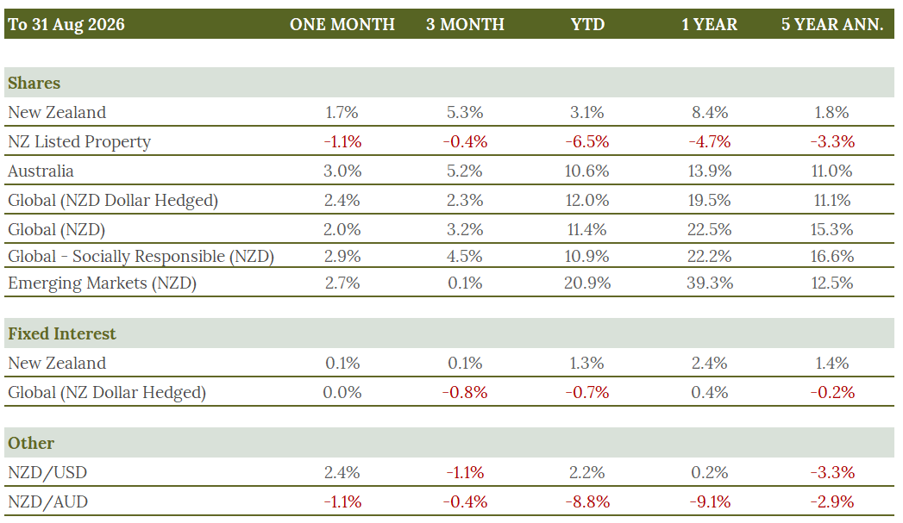
Global share markets resumed their upward momentum in August. Global shares returned 2%, extending their gains over the past year to more than 20%. Strong company earnings and continued enthusiasm around artificial intelligence supported markets. The US S&P 500 rose 2.7% in US-dollar terms, with Nvidia gaining approximately 10% during the month. However, performance among the largest technology companies remained mixed, highlighting that investors are becoming more selective about which businesses will benefit most from the significant investment in AI infrastructure. Microsoft and Nvidia were particularly influential, while Broadcom was among the weaker large semiconductor companies.
Emerging-market shares also recovered from July’s sharp decline, returning 2.7% in New Zealand-dollar terms. Taiwan and South Korea rebounded as sentiment towards AI-related semiconductor companies improved, while China was held back by continuing weakness in domestic demand. Emerging markets remain the strongest-performing major sharemarket segment over the past year, returning 39.3%.
Currency movements continued to influence returns for New Zealand investors. The New Zealand dollar strengthened 2.4% against the US dollar during August, reducing the return from unhedged global shares. It weakened 1.1% against the Australian dollar, providing an additional benefit to New Zealand investors holding Australian assets.
Australasian shares
Australian shares gained 3.0% in August, taking their return for the year to date to 10.6%. Company earnings were generally supportive, with healthcare the strongest-performing part of the market. Mining and materials companies also benefited from stronger commodity prices, while the weaker New Zealand dollar added to returns for local investors.
The New Zealand share market rose 1.7%, with the reporting season producing a wide range of results. Spark was one of the stronger performers after reporting better-than-expected revenue, a 23% increase in adjusted earnings and an improved outlook for cash generation. Heartland Group also responded positively after almost doubling underlying profit, while Skellerup reported another record annual result.
However, not all results were well received. a2 Milk fell sharply after supply-chain disruption affected its Chinese-label infant formula business and management provided a softer outlook for the coming year. Auckland Airport also faced concerns about the funding requirements for its substantial investment programme and uncertainty over the Commerce Commission’s approach to regulated returns.
New Zealand listed property declined 1.1% during August and remains down 6.5% for the year to date. The sector continues to be affected by elevated long-term interest rates, which increase financing costs and make the income offered by property companies less attractive relative to bonds and term deposits.
Fixed interest
Bond returns were broadly flat after July’s declines. New Zealand fixed interest gained 0.1%, while global hedged fixed interest was unchanged. However, this relatively subdued result concealed further pressure on longer-term government bonds. The US 30-year Treasury yield rose above 5% during the month and reached its highest level since 2007, while long-term yields in Germany and Japan also approached multi-decade highs.
Concerns about government debt and persistent inflation remain the main drivers of higher yields, but the AI investment boom is increasingly part of the story. Microsoft, Amazon, Alphabet and Meta are investing heavily in data centres, computing capacity and energy infrastructure. Funding this expansion is expected to require substantial corporate borrowing, increasing the supply of bonds available to investors and placing upward pressure on yields.
These pressures are occurring alongside high government borrowing, particularly in the United States, and concerns about whether central banks can return inflation sustainably to target. Higher yields reduce the market value of existing bonds and can also affect other investments by increasing financing costs and the discount rates used to value future company earnings. Technology companies have so far been supported by strong profit growth, but persistently higher yields would eventually make their elevated valuations more difficult to justify.
Despite these pressures, the income earned from bonds and comparatively stronger performance from corporate credit offset much of the decline in government bond prices during August. Today’s higher yields should also support better long-term income returns, although the path is likely to remain uneven. New Zealand’s relatively stronger fiscal position offers some protection, but domestic long-term yields will not be immune from developments in larger global bond markets.
