The Iran Conflict and Kiwi Finances
 By Chelsea Traver
Recent months have been marked by escalating US-Israel tensions with Iran, causing volatility in global markets, surging energy prices, and widespread uncertainty. After an initial sell-off, share markets rebounded and ended April at record highs.
What happened?
On 28 February, US and Israel airstrikes on Iran led to retaliation against US bases and Gulf allies, disrupting air traffic, supply chains, and global markets. Notably, the Strait of Hormuz, crucial for oil and gas transport, saw major disruptions, pushing Brent crude oil above $110 per barrel by month-end, amid failed ceasefire efforts.
Petrol prices
The effects of global conflict have been most directly observed by Kiwis through petrol prices.
Higher oil prices mean higher prices across many sectors, impacting goods such as groceries, airline tickets and business operations. According to the International Monetary Fund (IMF), a 10% increase in energy prices is projected to raise global inflation by nearly 0.5%. As noted by Kiwibank chief economist Jarrod Kerr: "A spike in petrol prices acts like a tax on the consumer."
In late April, petrol prices in NZ hit a record high, although there has been a modest decline in recent days. Experts caution this respite may be temporary, given ongoing upward trend in global oil prices.
NZ imports more than 90% of its refined fuel from Asian refineries located in South Korea, Singapore, Malaysia and Japan. Those refineries source over three-quarters of their crude oil from the Persian Gulf. As access through the Strait of Hormuz becomes more constrained, competition for alternative supply intensifies, resulting in higher domestic fuel prices.
On a more positive note, New Zealand and Singapore have just this week agreed to maintain critical fuel supplies during periods of crisis, a significant development considering the nation’s reliance on this supply chain.
Inflation and economic growth
Rising petrol prices are already contributing to higher inflation. In the US, inflation rose 3.3% in the most recent results, marking the highest monthly rise since April 2021. While NZ’s latest inflation data haven’t been released yet, the next quarterly CPI (June 2026) is expected to climb.
There are also concerns for our farming sector. About 45% of global urea (NZ's most widely used nitrogen fertiliser) moves through the Strait of Hormuz. With urea prices surging, if higher prices persist, farmers will face greater input costs, which could lead to higher food prices at the supermarket.
The housing market
Many New Zealanders are focussed on what’s happens with house prices and mortgages. ANZ has cut its 2026 house price inflation forecast from 5% to just 2%, citing weaker buyer confidence and upward pressure on mortgage rates as wholesale interest rates rise sharply.
Mortgage rates have moved quickly. BNZ has raised the three year fixed-term mortgage rates by 10 basis points, its second increase in two weeks, citing the oil crisis and related inflationary pressure. Across the market, regular fixed rates now start at 4.59%, and longer-term fixed rates reach 6.39%.
ANZ now expects the first OCR hike in December 2026 and sees a chance it could come even sooner. However, most economists still think a dramatic fall in house prices is unlikely and predict a modest recovery starting from 2027, assuming the energy situation stabilises.
The Share Market — sell-off, followed by a stunning recovery
Global stocks fell sharply in the weeks after the conflict began. However, April marked the MSCI World Index's best monthly performance since November 2020, closing at a record high.
The S&P 500 rose 10.4% for the month. The S&P 500 underwent a 13-day rally to close at a new all-time high on April 24, advancing sharply following news of progress between the US and Iran.
The standout international performer was the MSCI Emerging Markets Index, gaining 14.7%, powered by extraordinary gains in Taiwan and South Korea, both key players in the global AI supply chain.
Several factos contributed to the market recovery; a strong start to earnings season and renewed enthusiasm in AI played key roles, even as the Strait of Hormuz remained severely restricted and elevated oil prices. Investor sentiment shifted toward risk-taking.
The NZ energy sovereignty opportunity
NZ generates around 85% of its electricity from renewable sources, making it one of the world leaders. Despite this, recent conflicts has exposed a major weakness. NZ’s oil reserves are entirely stored offshore. In January, the country held 38 days’ worth of petroleum stocked domestically, whereas countries such as Japan and South Korea hold around 200 days locally.
The Iran conflict offers NZ an opportunity to reconsider its approach: shifting from simply promoting electric vehicles (EVs) as environmentally friendly, to highlighting how charging EVs with local renewable energy sources protects drivers from international crisis that could dispurpt petrol supplies. The move toward electric transport and clean, homegrown energy is not only better for the planet, but is now vital for national economic security.
What’s next?
It’s understandable to feel anxious. The news is concerning and affects everyday life, impacting fuel prices, groceries, and mortgages but the share market recovery sends a hopeful message.
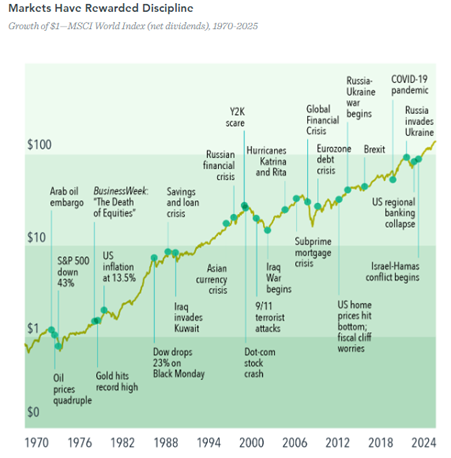
History shows that market recovery times have shortened considerably over recent decades. The recovery after the 2026 Iran conflict took only 11 days— one of the fastest on record. In 8 out of 10 major geopolitical events since 1980, markets were positive a year later, after three years, every single case showed gains.
The leap from March lows and April record highs happened in just weeks, reinforcing the idea that reacting hastily to uncertainly costs more than staying the course through volatility.